

By Joey Gunning, Director of Economic Development, Greater Spokane Inc.
Recently, something caught my eye: the historical trend of Dietetic Technicians in Spokane County.
Maybe it will catch yours, too:
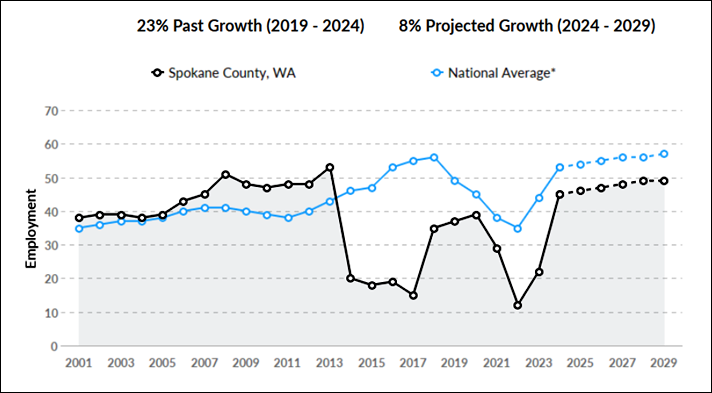
I came across this graph because I noticed that from 2022-2025, the fastest growing occupation in Spokane County (by percentage) was Dietetic Technicians – up 283%. I know it’s not a substantially large number of jobs (currently 46 in Spokane County) but it was still intriguing to me. What was causing this massive spike in Dietetic Technicians?
As it turns out, it’s actually a rebound. Spokane had sharp declines in 2014 and again in 2020.
The 2020 drop makes sense. COVID impacted jobs across the board. But what happened in 2014?
I learned that before 2014, only doctors could write diet orders in hospitals and long-term care. That meant that if a patient needed a change in their diet, a doctor had to sign off, even if the Registered Dietitian Nutritionist (RDN) or Dietetic Technician knew exactly what was needed.
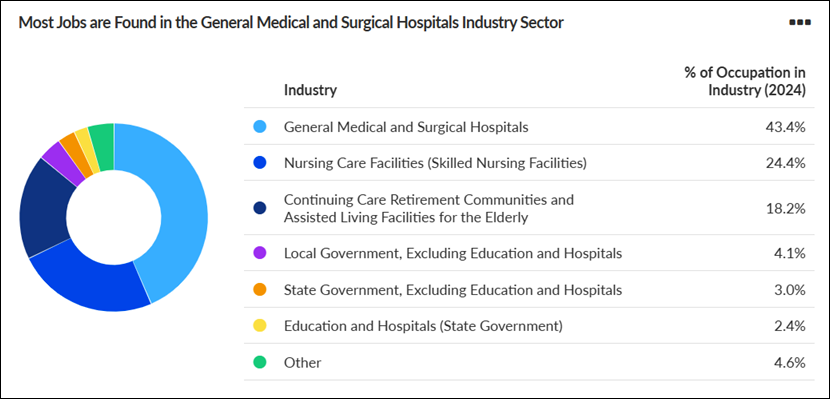
But in 2014, the Centers for Medicare & Medicaid Services (CMS) issues a new rule: RDNs could write diet orders directly if the hospital chose to grant them that privilege. This made care more efficient and elevated the role of the RDN. Since RDNs could do the work without going through doctors, or relying on Dietetic Technicians for certain steps, many hospitals restructured their teams.
In places like Spokane, where Dietetic Technicians were widely used, that meant a sudden reduction in Dietetic Technician roles. Nationally, the effect was diluted because many regions weren’t as reliant on Dietetic Technicians in the first place.
Through the late 2010s, national declines in dietetic technician programs further thinned the pipeline of new works, then COVID disrupted food and nutrition services, accelerating retirements and workforce shortages.
Since 2022 though, demand has bounced back. Health systems like Providence and MultiCare have been rehiring into these roles, particularly in patient services and pediatrics, helping drive Spokane’s surge.

Today, Spokane still sits below the national average for Dietetic Technician employment, but compensation is 27% higher here, and the field is projected to grow another 8% over the next five years.
This story is a striking example of how regulation, education pipelines, and local demand interact to reshape a profession over time. When you zoom out, the “why” behind the numbers can be just as important as the numbers themselves.
This kind of thing is exactly what THRIVE Spokane, our region’s Comprehensive Economic Development Strategy, is designed to tackle. It’s about building resilient economies that allow us to recover and adapt. A single federal rule in 2014 reshaped a local workforce overnight. Lessons learned here can inform how we prepare for changes in other occupations, from healthcare to advanced manufacturing. We can align education and training capacity with actual employer demand, and diversify and strengthen critical occupations so local economies aren’t overly vulnerable to single shocks.